

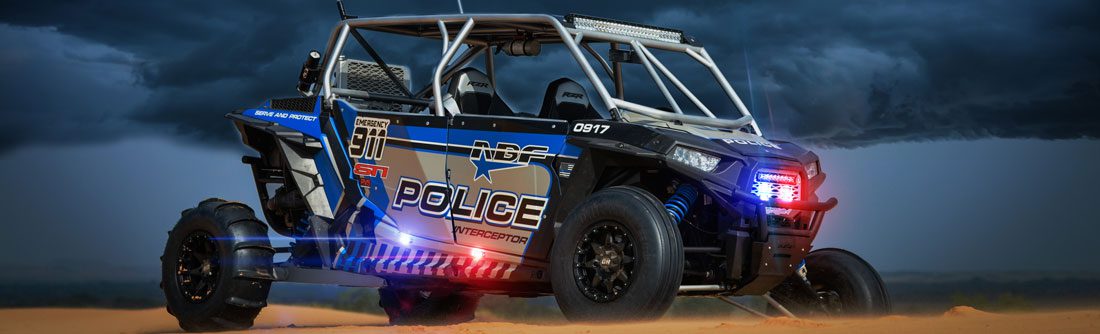
Emergency vehicle warning equipment includes a variety of visual and audible signaling devices, which are designed to increase vehicle visibility and alert surrounding traffic when first-responders are on the site for emergency response, roadside assistance, and public safety operations. These emergency systems are used by police, fire teams, EMS, tow trucks, construction workers, and utility vehicles. Not only does emergency warning equipment reduce the risk of accidents, but the right equipment makes it easier to improve roadway safety for everyone in the area.
High-quality emergency vehicle lights and sirens are essential for roadside safety because they increase visibility and awareness. These tools can alert other drivers when emergency responders, roadside assistance, and other public safety response vehicles are in the area, helping to reduce the risk of accidents and ensure the safety of all drivers. Research from the U.S. Fire Administration’s Emergency Vehicle Visibility and Conspicuity Study (FA-323) confirms that active visual warning systems are among the most effective tools for protecting on-scene responders.
Two of the most common types of signaling equipment for emergency vehicles are 1) strobe or LED lighting, and 2) emergency sirens and speakers. While both types of signaling equipment can be used individually, the safest solution is to use a setup with both visual warning and audible notification.
This article explains the types of emergency vehicle lighting and emergency vehicle sirens and speaker options, and how to determine the right types of lights and/or sirens for your unique needs. These products are often used for police, fire, EMS departments, tow truck operators, snow plows, fleets, construction, and utility vehicles.
What Emergency Vehicle Lighting Technologies Are Available?
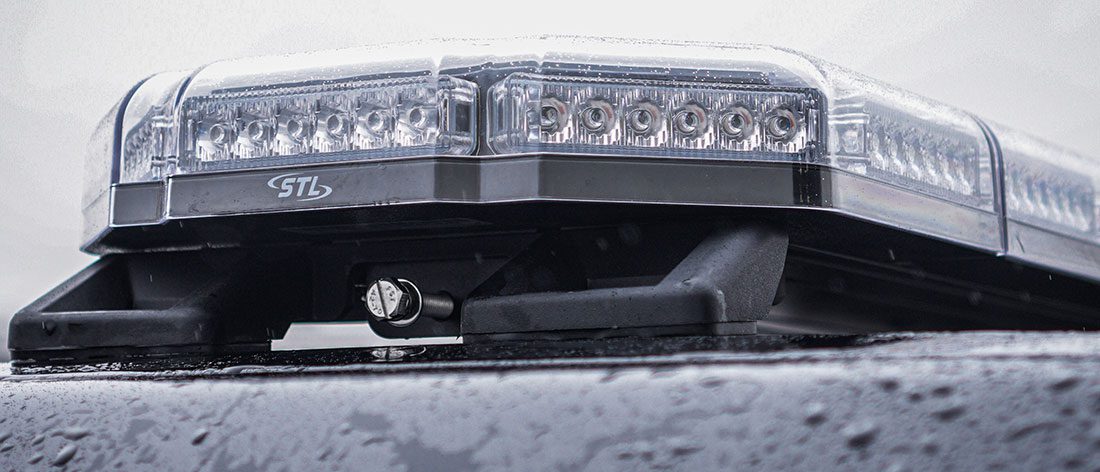
Emergency vehicle lights have improved over the years, beginning with halogen technology, then strobe, and finally the latest generation using LED technology. While some experts agree that strobe technology is superior to halogen, it’s clear that LED technology-based emergency vehicle lighting is an ideal solution because it ensures the brightest and most visible light output available on the market today. Note: “strobe” is often used to describe any rapid-flash warning pattern, and modern LED lights replicate these patterns without the fragility of older xenon gas-discharge strobe tubes.
| Feature | Halogen | Xenon Strobe | LED (Current Standard) |
|---|---|---|---|
| Light Output | Low | High (peak only) | Highest – sustained |
| Lifespan | ~1,000 hrs | ~10M flashes | 50,000+ hrs |
| Energy Draw | High | Moderate–High | Low |
| Flash Pattern Control | Limited | Limited | Fully programmable |
| Vibration Resistance | Poor | Fragile | Excellent |
| IP Rating Achievable | Low | Moderate | IP67 / IP68 |
| SAE Class 1 Capable | Rarely | Some units | Yes |
| Maintenance | Frequent bulb changes | Tube replacement | Near zero |
Interior vs. Exterior Emergency Vehicle Lighting: Visibility and Installation
Interior Emergency Vehicle Lighting
Interior emergency vehicle lighting refers to any warning light products installed in the vehicle cabin. Examples include lights that are mounted behind the windshield with a visor light bar or headliner mounting bracket, suction cup mounted to the glass, or L-shaped brackets attached to the front dash or rear deck. When choosing interior lighting, proper product selection ensures that you have an unmarked, “slick top”, low profile appearance.
These interior lighting products are perfect for police, security, utility, construction supervisors, and trucks. Interior emergency lighting makes it possible to maintain a professional appearance with a customized warning notification system.
Another advantage of interior LED lights is that interior mounting protects them from the elements. The vehicle cabin shields the warning light from weather, obstacles, and tampering. Many deck and dash LED lights can also be operated using a cigarette lighter plug, providing flexibility and ease of installation.
Exterior Emergency Vehicle Lighting
Exterior vehicle lighting refers to any warning light products installed on the outside of the vehicle. They can be mounted in the grille, roof-mounted, or surface-mounted directly to the vehicle. When you need maximum visibility, then exterior vehicle warning lights are often the best choice. Even though exterior LED light installations can be more intensive than interior installations, they provide a more secure, long-term solution.
These exterior lights are perfect for fire trucks and other large vehicles, such as tow trucks, police cruisers, and roadside construction. Exterior vehicle lighting provides maximum protection and visibility for oncoming traffic.
Another advantage of exterior LED lights is that there are many mounting options for LED warning lights, unlike the limitations of internal installation.
- Many roof-mounted mini light bars come with magnetic mounts for easy placement
- Other types of permanent mounting brackets are available for full light bars, including vehicle-specific designs and headache rack options
- Surface-mount LED lights can be placed on any flat surface for ultimate flexibility and visibility
- Lights can even be mounted to the running board for off-axis positioning
- Tailgate light bars give an added visibility boost to trucks and construction vehicles
| Factor | Interior Lighting | Exterior Lighting |
|---|---|---|
| Best For | Unmarked / slick-top vehicles, police, security, supervisors | Fire apparatus, tow trucks, marked police cruisers, and construction |
| Visibility | Forward-facing; limited side/rear coverage | 360° possible; maximum from all angles |
| Installation | Simple; often cig-plug operated | More intensive; permanent brackets, grille, or roof mount |
| Weather Exposure | None – cabin-protected | Full exposure – weatherproofing or IP rating critical |
| Concealment | High – low-profile / slick-top | Visible – signals emergency status to all traffic |
💡 IP Rating Guide for Emergency Lights
IP67 = Fully dust-tight + waterproof to 1 meter immersion for 30 minutes.
IP68 = Deeper / prolonged submersion.
Interior-mounted products can function at lower or non-IP ratings since the vehicle cabin provides natural weather protection.
What Emergency Vehicle Siren and Speaker Options are Available?
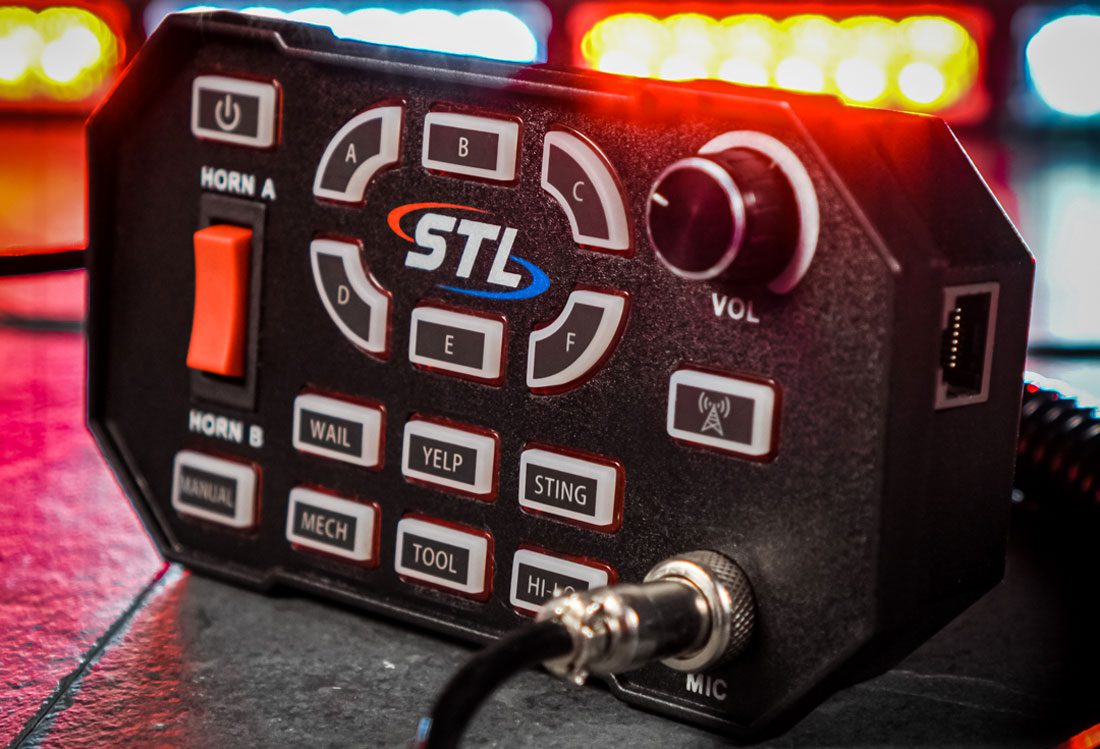
There are two main types of emergency vehicle and police sirens: high frequency and low frequency. High-frequency sirens are the most common type and operate at 1-3 kHz, which is the most sensitive range for human ears. Low-frequency sirens operate at a range below 1 kHz and are designed to complement high-frequency sirens by adding deep, rumbling tones and vibrations.
High Frequency vs. Low Frequency Emergency Vehicle Sirens: The Difference in Sound Range and Performance
- High-Frequency Sirens: These sirens are best for clear, sharp, and piercing tones when you need to warn traffic that emergency vehicles are moving through the area. They are the most common types of police and emergency sirens and usually operate at a sound level of 120db measured at 1 meter
- Low-Frequency Sirens: These low-frequency options are not designed to be used alone. They work well with high-frequency sirens by adding tones at a lower frequency, which creates a stronger warning that penetrates vehicles better than high-pitched sounds. The dual approach improves safety and response times. Low-frequency sirens are most useful in noisy and dense urban environments because they can cut through loud city noises
| High-Frequency Siren | Low-Frequency Siren | |
|---|---|---|
| Frequency Range | 1–3 kHz | Below 1 kHz |
| Sound Level | ~120 dB at 1m | Supplements HF; varies by unit |
| Tone Character | Sharp, piercing, clear | Deep, rumbling, palpable vibration |
| Best Environment | Open roads, moderate traffic | Dense urban; penetrates vehicle cabins & buildings |
| Standalone Use | Yes – primary siren system | No – must be paired with a high-frequency siren |
What Are the Different Types of Emergency Siren Speakers?
Emergency siren speakers are typically available in two formats: a cone and a slim speaker format. Cone speakers typically have a much larger footprint, and the cone concentrates the sound output towards the center of the speaker. Slim speaker formats are compact and offer a broad output with a wider degree of sound.
Cone vs Slim Speakers for Mounting Flexibility and Optimal Sound Projection
- Slim Speakers: Since these speakers are compact, they make it easier to mount them in low-profile areas, either behind the grille or mounted to the push bumper. Security and police tend to prefer the slim speaker because they need a low-profile appearance
- Cone Speakers: These speakers are more commonly chosen by Fire, EMS, and other large trucks because they have a larger footprint. Cone speakers are also cheaper compared to other sirens, which is why they are a popular choice for budget-conscious police departments and security fleets
Why does projection direction matter? Cone speakers concentrate output in a forward direction, which is ideal when you need the sound to cut through heavy approaching traffic. On the other hand, slim speakers have a wider dispersion, which is preferred if you need broad coverage. Because of the longer wavelengths, low-frequency sound waves penetrate vehicle cabins and building walls better. When you need the most effective setup for dense urban environments, then the best solution is to combine both speaker types and siren frequencies.
| Factor | Cone Speaker | Slim Speaker |
|---|---|---|
| Sound Projection | Directional – concentrated forward | Wide – broad 180° dispersion |
| Footprint | Large – requires significant mounting space | Compact – fits tight / low-profile areas |
| Mounting Options | Push bumper, grille (front-heavy applications) | Behind grille, push bumper, low-profile recesses |
| Typical Users | Fire apparatus, EMS, large trucks | Police, security, unmarked vehicles |
| Cost | Generally more economical | Moderate Premium |
| Best For | Large vehicles; strong forward projection | Unmarked / discreet installs; slick-top vehicles |
How To Determine A Quality Light and Siren?
There are many factors to consider when choosing quality lights and sirens for your vehicles. Always look at manufacturer warranties, reviews, and independent third-party analyses before making a decision. You can also find more information on platforms like TrustPilot, Shopper Approved, and Google, where other customers are sharing their experiences.
Keep in mind that the most important metrics are product certifications coming from independent third-party laboratories. In these settings, the emergency vehicle equipment is carefully evaluated under strict metrics, then the laboratory grades quality and performance according to the SAE standard. These are the priorities when evaluating equipment:
- SAE certification class
- Weather protection
- Manufacturer warranty
- Independent reviews
Always check state compliance, especially since requirements vary by jurisdiction.
What Are SAE Standards for Emergency Vehicle Equipment?
SAE International standards are globally recognized. These voluntary technical guidelines ensure safety, quality, and interoperability in the automotive, aerospace, and commercial vehicle industries. They establish benchmarks for vehicle components, including lighting and more. For emergency vehicle lighting specifically, the two primary standards are SAE J595 (directional) and SAE J845.
SAE J595 vs J845: Emergency Lighting Standards Explained
SAE J595 and J845 are standards that define the quality of an LED emergency vehicle warning light. These standards test for light output performance as well as housing and circuitry consistency, and torture tests. Both standards require vibration testing, humidity testing, dust protection testing, corrosion testing, temperature testing, and duty cycle testing to ensure top performance across all environments.
- SAE J595 is the standard for emergency vehicles with directional, single-color, flashing optical warning lights. This standard covers photometrics, intensity, color, and durability for warning lights. The light output is assigned Class 1, 2, or 3 based on performance, with Class 1 being the best quality. Classes for a lighting product are only given when all other tests have also been passed successfully
- SAE J845 is the standard for omnidirectional, 360-degree, optical warning devices used on emergency, maintenance, and service vehicles. This standard defines performance requirements for intensity, flash rate, and color, similar to the J595 standard
The main difference you need to understand is that the J845 standard is for warning lights that output 360 degrees of direction, while the J595 standard is for warning lights that output in one direction only.
| SAE J595 | SAE J845 | |
|---|---|---|
| Light Direction | Directional – aimed at a specific angle (±10°–20°) | Omnidirectional – full 360° coverage |
| Typical Products | Grille lights, stick lights, surface mounts, traffic advisors | Light bars, mini bars, beacons, rotating lights |
| Class Ratings | Class 1, 2, 3 (Class 1 = highest intensity) | Class 1, 2, 3 (Class 1 = highest intensity) |
| Flash Rate | 60–120 FPM (flashes per minute) | 60–120 FPM |
| Required Tests | Vibration, humidity, dust, corrosion, temperature, duty cycle | Same as J595 |
| SAE Class | Intensity Level | Intended Application | Typically Required For |
|---|---|---|---|
| Class 1 | Highest – full-duty emergency | Police, fire, EMS – vehicles with legal right-of-way authority | Most state codes for active emergency vehicles |
| Class 2 | Moderate – service / maintenance | Tow trucks, roadside service, utility vehicles | Service and maintenance vehicle regulations |
| Class 3 | Lower – slow-moving / stationary | Construction equipment, low-speed or stationary warning use | Stationary or low-speed warning applications |
Frequently Asked Questions About Emergency Vehicle Lights and Sirens
Which Type of Emergency Lighting Technology Is Best?
LED emergency lighting has the brightest light output and is best for maximum visibility, making it the preferred choice for most emergency vehicles. LED lights offer 50,000+ hour lifespans, programmable flash patterns, weatherproofing, and SAE Class 1 certification. None of these features is consistently achievable with halogen or xenon strobe technology.
Are Non-SAE Rated Lights The Same As SAE Class Lights?
No. SAE Class lights have been proven to perform and meet specific metric standards so they are compliant with the needs and standards of emergency vehicles. Non-SAE rated lights carry no independently verified performance data. Most state regulations for active emergency vehicles require SAE Class 1 certification, which means that you will likely have legal and liability exposure when using non-rated equipment.
Can A Low Frequency Siren Be Used Alone?
No, a low-frequency siren shouldn’t be used without a high-frequency siren pairing. A setup with only low-frequency tones is not an effective emergency warning output. Low-frequency sirens are supplemental devices, not primary warning systems.
Can I Install Both Interior Lights and Exterior Lights?
Yes. Installing both interior and exterior emergency vehicle lighting is the best balance between low profile and maximum visibility. Interior lighting provides forward-facing warning with a discreet profile; exterior lighting delivers maximum 360° visibility. Many law enforcement and fire vehicles run both interior and exterior lights simultaneously for complete coverage.
What SAE class do I need for a police or fire vehicle?
Most state codes require SAE Class 1 certification for police, fire, and EMS vehicles operating with right-of-way authority. Class 1 represents the highest tested intensity under both SAE J595 and SAE J845. Always verify your state’s specific requirements to ensure that your vehicles are in compliance.
What do IP67 and IP68 ratings mean for emergency lights?
IP67 = fully dust-tight, waterproof to 1 meter immersion for 30 minutes. IP68 = deeper, prolonged submersion.
Do emergency vehicle lights need to comply with federal or state law?
Emergency vehicle lights must comply with BOTH federal and state laws. FMVSS No. 108 establishes the federal OEM baseline for vehicle lighting. However, active emergency warning lights are primarily regulated at the state level, including permitted colors, minimum SAE classes, and authorized vehicle types. Everything varies by jurisdiction, which is why it’s necessary to check the requirements in your local area. SAE certification (J595/J845) is the industry standard most state laws reference.
Choosing the Right Emergency Lighting and Siren Setup for Your Vehicle
There are many options to consider when choosing emergency vehicle lights and sirens. Interior lighting offers easy installation, protection, and concealment. Exterior lighting is a better option if you need a more permanent and higher visibility solution. The best setup will cover a good mix and balance of both interior and exterior lighting.
When it comes to sirens, a standalone high-frequency siren works great, but pairing it with a low-frequency siren system will improve its reach and effectiveness, especially in dense urban settings.
When public safety professionals choose the best emergency vehicle lights and sirens, it’s critical to understand how they function for both visibility and safety.
| Vehicle Type | Recommended Lighting | Recommended Siren Setup | Key Standard |
|---|---|---|---|
| Police (marked) | Full-size Class 1 bar + grille lights | High-freq + low-freq pair; slim speaker | SAE J595/J845 Class 1 |
| Police (unmarked) | Interior visor/dash lights + hideaway kit | High-freq + low-freq pair; slim speaker | SAE J595 Class 1 |
| Fire Apparatus | Full-size exterior bar + running board lights | High-freq; cone speaker | SAE J595/J845 |
| EMS / Ambulance | Full-size bar + surface mounts | High-freq + low-freq pair; cone speaker | SAE J595/J845 |
| Tow Truck | Amber full-size or mini bar + traffic advisor | N/A | SAE J595/J845 Class 1 or 2 |
| Construction/Utility | Amber mini bar or beacon lights | N/A | SAE J595/J845 Class 1 or 2 or 3 |
🛒 Shop SAE-Certified Emergency Vehicle Warning Equipment at SpeedTech Lights
SpeedTech Lights has supplied law enforcement, fire, EMS, tow operators, and fleet managers with SAE-certified emergency lighting and sirens for over 20 years. BBB A+ Rated. Free shipping on orders $50+ (code: FREESHIP). Government purchase orders accepted.
Questions? Call (800) 757-2581 | Mon–Fri, 9:00am–4:00pm CST | CustomerService@SpeedTechLights.com
Standards & Resources Referenced in This Article
- SAE J595 – Directional Flashing Warning Devices (Class 1/2/3)
- SAE J845 – Omnidirectional Optical Warning Devices (Class 1/2/3)
- USFA / FEMA FA-323 – Emergency Vehicle Visibility and Conspicuity Study